
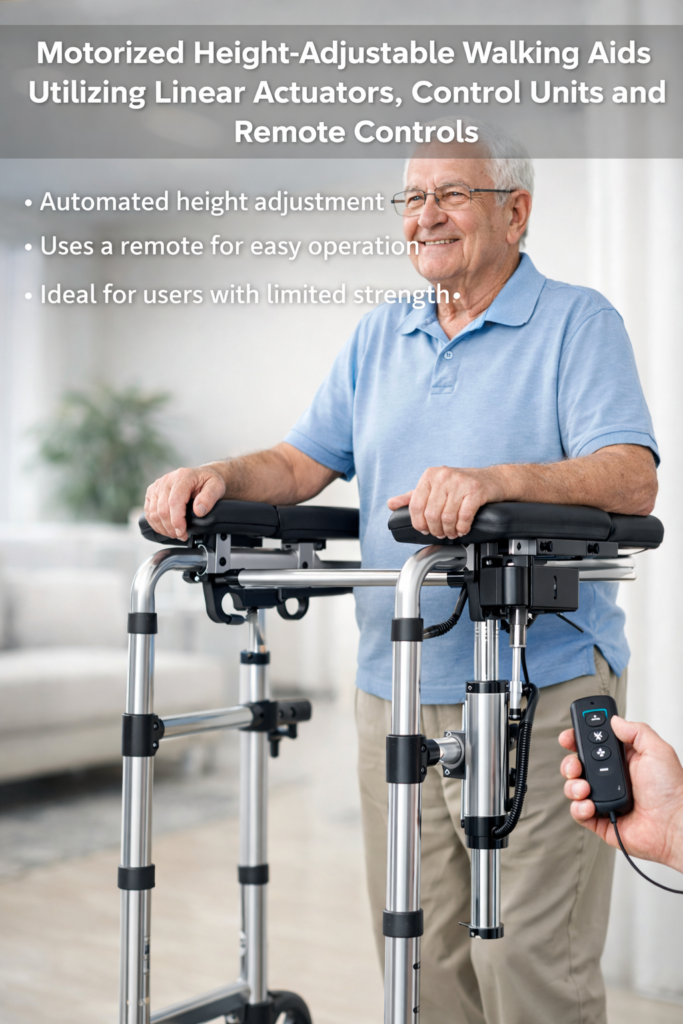
Height-adjustable walking aids with linear actuator help users change height with a remote. Because the system is motorized, no force is needed. As a result, posture stays correct and movement feels safe. Overall, these aids improve comfort, confidence, and daily independence.
Introduction
Today, mobility support is changing fast. Instead of manual pin adjustments, many walking aids now use motorized systems. Because of this change, height adjustment becomes smooth and easy. At the same time, user safety improves. The product clearly shows this modern design approach.
Key Features and Technology
- Linear Actuator: To begin with, it turns motor motion into straight movement. Therefore, the frame moves up or down smoothly.
- Control Unit: In addition, this unit controls power and direction. As a result, movement stays safe and stable.
- Remote / Hand Control: Moreover, the remote allows easy operation. Even elderly users can adjust height without help.
- Power System: Typically, the system runs on 12V or 24V DC. Because of this, operation remains quiet and efficient.
- Safety Protection: Finally, limit switches stop motion at safe points.
Required Components
To make such a walking aid work properly, several parts are needed. First, a medical-grade linear actuator is essential. Next, a control unit manages movement. After that, a remote or hand control is added. Additionally, a DC power source is required. Lastly, a strong yet lightweight frame completes the system.
How It Is Used
First, the user presses a button on the remote. Then, the control unit receives the signal. Next, the actuator starts moving. As a result, the height changes smoothly. Finally, the system stops automatically for safety.
Steps to Follow
- First, mount the actuator firmly to the frame.
- Then, connect it to the control unit.
- After that, fix the remote in a reachable place.
- Next, switch on the power and test movement.
- Finally, confirm stability before daily use.
Checklist Before Buying
Before choosing a product, consider these points:
- Correct height adjustment range
- Weight capacity matches the user
- Smooth and quiet operation
- Safety cut-off feature included
- Simple and clear remote buttons
Key Application Areas
These walking aids are widely used today. For example, they support patients in rehabilitation centers. Similarly, hospitals rely on them for assisted mobility. In addition, home-care users benefit from easy adjustment. Moreover, they help neurological and post-surgery patients.
Real-World Examples
For instance, motorized gait trainers like Morecare i-Gait allow controlled posture support. Likewise, sit-to-stand wheelchairs use actuator systems for smooth lifting. Meanwhile, fall-assist devices such as VOCIC help users rise safely after a fall. Overall, these examples show how actuator technology improves mobility.
Actuator-Based Systems in Modern Wheelchairs
In modern wheelchairs, actuator systems play a key role. For example, they support lifting, reclining, and standing functions. Because the movement is powered, effort is reduced. As a result, user comfort increases. Compared to manual systems, control and safety are much better.
Comparison: Manual vs Motorized Walking Aids
| Aspect | Manual Adjustment | Motorized Adjustment |
|---|---|---|
| Effort | High | Very Low |
| Speed | Slow | Fast |
| Accuracy | Limited | High |
| Safety | Depends on user | Auto-protected |
| Comfort | Basic | Advanced |
Advantages and Disadvantages
Advantages:
Firstly, no physical force is needed.
Secondly, posture accuracy improves.
Additionally, daily use becomes easier.
Most importantly, safety increases.
Disadvantages:
However, initial cost is higher.
Also, power or charging is required.
Still, maintenance is minimal.
Key Benefits & Specifications
- Smooth electronic height adjustment
- Lightweight but strong frame
- Quiet actuator operation
- Simple remote control use
- Designed for medical environments
FAQs
1. Best height adjustable walking aids using linear actuators with remote control
Motorized walkers with certified actuators offer the best performance.
2. Benefits of remote-controlled height adjustable walking frames
They reduce effort and improve safety.
3. Top companies manufacturing such walking aids in India
Several Indian rehabilitation and automation companies offer these systems.
4. Where to purchase motorized height adjustable walkers in India
They are available through medical equipment suppliers.
5. How does a control unit work in these walking aids?
It controls direction, power, and safety limits.
6. How does a linear actuator work in a smart walking aid?
It converts motor rotation into straight movement.
7. Where to buy remote-controlled walking aids in India?
Hospital equipment dealers and mobility solution providers sell them.
8. Comparison of electronic height adjustable crutches
Crutches are lighter but handle less load.
9. Reviews of motorized height adjustable walking aids
Most users report better comfort and ease of use.
10. Cost of powered walking sticks in India
Prices vary based on features and quality.
Conclusion
In conclusion, height-adjustable walking aids using linear actuators, control units, and remotes offer a clear improvement over manual designs. Because they reduce effort, they suit elderly and rehabilitation users well. Although the price is higher, the benefits last longer. Ultimately, the video product proves that smart mobility solutions truly enhance quality of life.