
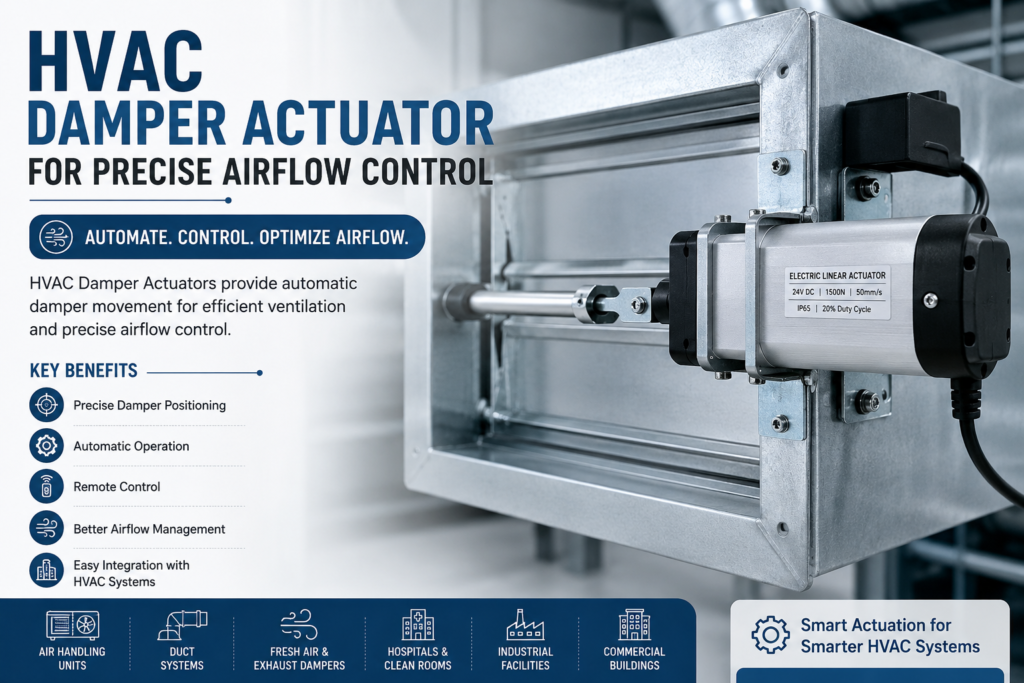
HVAC Damper Actuator for Precise Airflow Control
An HVAC damper actuator helps control airflow in heating, ventilation, and air conditioning systems. It moves the damper based on a signal from a controller. As a result, your HVAC system gets better airflow control and less manual operation.
Modern buildings and industrial facilities need accurate airflow control. Therefore, automated damper systems are useful in many HVAC applications.
What Is an HVAC Damper Actuator?
An HVAC damper actuator is a motorized device used to move an HVAC damper.
The actuator receives a control signal. Then, it moves the damper to the required position.
The damper can be:
- Fully closed
- Partially open
- Fully open
Electric linear actuators provide controlled linear movement. They extend and retract the actuator rod to move the damper.
How Does an HVAC Damper Actuator Work?
The working process is simple.
Controller → Control Signal → Actuator → Damper → Airflow Control
First, the HVAC controller checks the system condition.
Next, it sends a signal to the actuator.
Then, the actuator moves its rod.
As a result, the damper changes its position.
Finally, the airflow changes according to the required setting.
This process allows automatic airflow control without regular manual adjustment.
Benefits of an HVAC Damper Actuator
An HVAC damper actuator provides several benefits for ventilation systems.
Automatic Damper Control
The actuator moves the damper automatically. Therefore, operators do not need to adjust the damper by hand.
Precise Damper Positioning
The actuator provides controlled movement. As a result, the damper reaches the required position with better repeatability.
Better Airflow Control
Proper damper movement helps control the amount of air flowing through ducts. This supports stable ventilation.
Remote Operation
The actuator works with a control system. Therefore, operators can control dampers from a central location.
Easy System Integration
An HVAC damper actuator works with PLCs, HVAC controllers, sensors, and building automation systems.
Where Are HVAC Damper Actuators Used?
HVAC damper actuators are used in many applications.
For example:
- Air handling units
- HVAC duct systems
- Fresh-air dampers
- Exhaust-air dampers
- Return-air dampers
- Ventilation systems
- Clean rooms
- Hospitals
- Laboratories
- Factories
- Warehouses
- Commercial buildings
These applications often need automatic and reliable airflow control.
How to Select the Right HVAC Damper Actuator
The right actuator depends on your HVAC application.
Before selecting an actuator, check these specifications:
- Required force
- Stroke length
- Operating voltage
- Movement speed
- Duty cycle
- Mounting arrangement
- Control signal
- Position feedback
For example, a large damper might require higher actuator force. Similarly, a damper with a longer mechanical movement might require a longer stroke.
Therefore, match the actuator specifications with the damper requirements.
HVAC Damper Actuator and Automation
An HVAC damper actuator becomes more useful when connected to sensors and controllers.
For example, a temperature sensor detects a change in room temperature. The controller processes the information. Then, it sends a signal to the actuator.
The actuator moves the damper. As a result, the airflow changes.
Similarly, an airflow or pressure sensor can provide information to the controller. The controller then adjusts the damper position based on the system requirement.
This creates an automated airflow control process.
Electric Linear Actuator for HVAC Dampers
Electric linear actuators are suitable for HVAC damper applications that require controlled linear movement.
The actuator extends or retracts its rod to move the damper. Different actuator models offer different force, stroke, speed, and voltage options.
Therefore, you should select the actuator based on your damper size and application requirements.
Kathir Sudhir Automation provides electric linear actuator solutions for industrial and customized automation applications.
These solutions are suitable for applications where controlled and repeatable linear movement is required.
Why Use Automated Damper Control?
Manual damper control requires regular operator adjustment. In contrast, an automated system responds to control signals.
An HVAC damper actuator helps provide:
- Automatic operation
- Precise damper movement
- Better airflow management
- Remote control
- Repeatable operation
- Easy automation integration
- Reduced manual adjustment
Therefore, actuator-based damper control is useful for modern HVAC systems.
Conclusion
An HVAC damper actuator provides a simple way to automate damper movement and airflow control.
The actuator receives a signal from the HVAC controller. It then moves the damper to the required position. As a result, the system gets controlled and repeatable airflow.
For reliable operation, select the actuator based on force, stroke, voltage, speed, mounting, and control requirements.
Kathir Sudhir Automation offers electric linear actuator solutions for HVAC and industrial automation applications.