
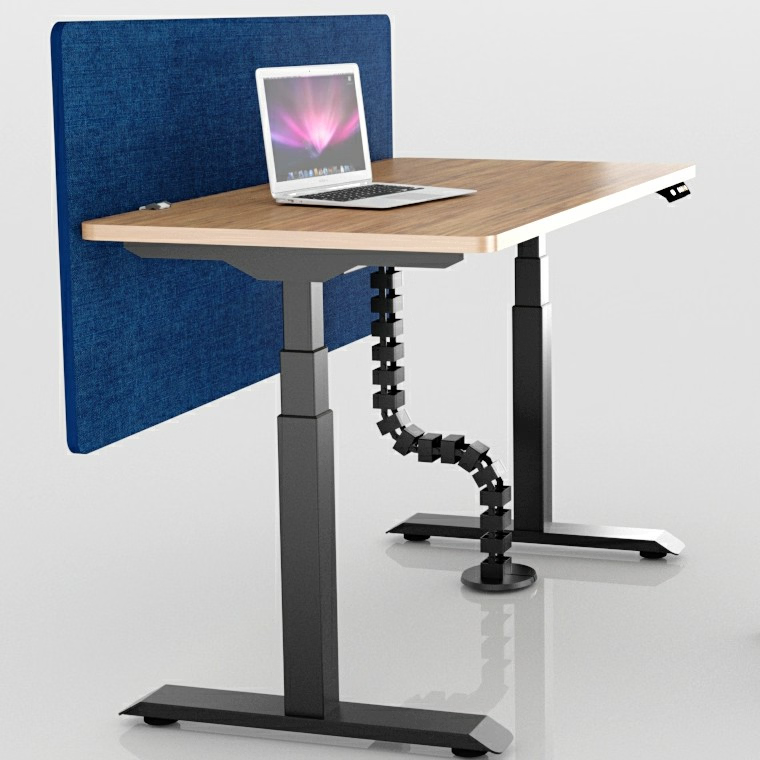
Modern workplaces need flexible workstations that support different users, tasks, and working positions. An electric linear actuator for height adjustment provides a practical way to automate workstation movement with controlled and repeatable linear motion.
Electric Linear Actuator for Height Adjustment Workstations
An electric linear actuator helps you raise and lower workstations with a simple button. It is useful for office desks, industrial workbenches, laboratory tables, packaging stations, and technical workstations.
The actuator converts electrical power into straight-line movement. You can control it with a switch, remote, push button, PLC, or control panel.
What Is an Electric Linear Actuator?
An electric linear actuator is a device that creates straight-line movement.
It usually includes:
- Electric motor
- Gearbox
- Lead screw
- Moving rod
- Housing
- Limit switches
When power is supplied, the motor moves the rod in or out.
For a height-adjustable workstation:
- Extending the actuator raises the table.
- Retracting the actuator lowers the table.
This makes height adjustment easier than using a hand crank or manual locking system.
How Does It Adjust Workstation Height?
A basic height-adjustable system includes an actuator, power supply, controller, mounting brackets, and a strong frame.
The operation is simple:
- Press the UP button.
- The controller sends power to the actuator.
- The actuator extends.
- The workstation moves upward.
- The actuator stops at the required position.
Press the DOWN button to lower the workstation.
For systems with two or more actuators, a synchronization controller helps keep the work surface level.
Where Are Height-Adjustable Workstations Used?
Electric linear actuators are suitable for:
- Industrial workbenches
- Assembly stations
- Packaging tables
- Laboratory tables
- Office desks
- Sit-stand desks
- Control room workstations
- Inspection stations
- Machine operator stations
- Technical workstations
Applications
1. Industrial Workbenches
Operators often need different working heights for assembly, inspection, maintenance, and production.
An electric linear actuator allows quick height adjustment without manual effort.
2. Assembly Stations
Assembly workers handle different tools, parts, and fixtures.
A motorized height adjustment system helps set the workbench to a comfortable working height.
3. Laboratory Tables
Laboratory equipment often needs flexible positioning.
An actuator allows users to raise or lower the table easily.
4. Packaging Stations
Packaging operations include filling, sealing, labeling, inspection, and packing.
Height adjustment helps operators work comfortably and allows the table to suit different processes.
5. Office Sit-Stand Desks
Electric actuators are widely used in sit-stand desks.
A control switch allows users to move the desk between sitting and standing heights.
6. Control Room Workstations
Control room operators often work for long periods.
Height adjustment helps users set the workstation to a suitable position for monitoring and operating equipment.
Benefits of Electric Linear Actuators
Using an electric linear actuator for workstation height adjustment provides:
- Easy push-button operation
- Smooth movement
- Reduced manual effort
- Controlled height adjustment
- Repeatable positioning
- Compact installation
- Different stroke options
- Different load capacities
- Different speed options
- Easy control integration
- Support for automation
- Suitable for OEM applications
How to Select the Right Actuator
Choose the actuator based on your workstation requirements.
1. Load Capacity
Calculate the total weight being lifted.
Include:
- Worktop
- Tools
- Monitors
- Equipment
- Instruments
- Fixtures
- Materials
Select an actuator with suitable lifting force.
2. Stroke Length
Stroke is the distance the actuator moves.
For example, if your workstation needs 400 mm of height adjustment, select a suitable actuator stroke based on your frame design and mounting position.
3. Speed
Speed determines how quickly the workstation moves.
Choose a faster actuator for frequent height changes. Choose a slower actuator when controlled movement is more important.
4. Duty Cycle
Duty cycle refers to how often the actuator operates.
An industrial workstation used frequently needs an actuator designed for the required operating cycle.
5. Retracted and Extended Length
Check the available installation space.
Measure the distance between the mounting points when the workstation is at its lowest and highest positions.
6. Voltage
Common actuator systems use 12 VDC or 24 VDC.
Select the voltage based on your power supply and controller.
7. Control Method
You can control an actuator using:
- Push buttons
- Hand controllers
- Remote controls
- Foot switches
- PLCs
- Microcontrollers
- Control panels
Electric Actuator vs Manual Height Adjustment
| Feature | Manual Adjustment | Electric Linear Actuator |
|---|---|---|
| Operation | Manual | Push button or automatic |
| User effort | Higher | Low |
| Position control | Manual | Controlled |
| Repeatability | Moderate | High |
| Automation | Limited | Easy |
| PLC integration | Difficult | Possible |
| Remote operation | Limited | Possible |
| Multi-actuator control | Difficult | Possible |
Electric height adjustment is useful when the workstation height needs to change frequently.
Safety Features
Safety should be considered when designing a height-adjustable workstation.
Useful features include:
- Limit switches
- Overload protection
- Emergency stop
- Current monitoring
- Anti-collision protection
- Stable frame design
- Proper actuator mounting
- Controlled starting and stopping
Limit switches prevent the actuator from moving beyond its designed travel.
Overload protection helps protect the actuator from excessive load.
For workstations used close to people, anti-collision protection adds another safety layer.
Using Two or More Actuators
Large workstations often need two or more actuators.
Multiple actuators help distribute the load. A synchronization controller helps them move together and keeps the work surface level.
Before selecting a multi-actuator system, check:
- Total load
- Load distribution
- Stroke
- Speed
- Frame strength
- Synchronization
- Controller capacity
- Duty cycle
- Safety requirements
This setup suits large workbenches, office desks, laboratory tables, equipment platforms, and industrial workstations.
Custom Electric Linear Actuator Solutions
Every workstation has different requirements.
A custom actuator solution might need different:
- Force
- Stroke
- Speed
- Voltage
- Mounting dimensions
- Feedback
- Limit switches
- Connectors
- Control systems
- Duty cycle
For example, a small workstation might need a compact actuator. A heavy industrial workbench might need higher force and a longer stroke.
Why Use an Electric Linear Actuator for Workstations?
An electric linear actuator provides simple and controlled height adjustment.
It helps manufacturers build flexible workstations for different users and applications. It also supports integration with PLCs, switches, control panels, and other automation systems.
Before selecting an actuator, check:
- Lifting force
- Stroke length
- Operating speed
- Duty cycle
- Voltage
- Mounting dimensions
- Load distribution
- Control method
- Safety requirements
- Positioning requirements
Frequently Asked Questions
What does an electric linear actuator do in a workstation?
It raises and lowers the workstation using powered linear movement.
How much weight can an actuator lift?
The capacity depends on the actuator model. Calculate the complete moving load before selecting the actuator.
Can two actuators work together?
Yes. A suitable controller can synchronize two or more actuators.
Can I control an actuator with a PLC?
Yes. The actuator system can be connected to a PLC when the electrical specifications are compatible.
How do I choose the stroke length?
Measure the required height difference between the lowest and highest workstation positions. Also consider the actuator mounting geometry.
Are electric linear actuators suitable for industrial workstations?
Yes. Select the actuator based on load, stroke, speed, duty cycle, installation space, and operating environment.
Conclusion
An electric linear actuator provides easy height adjustment for office desks, industrial workbenches, assembly stations, packaging tables, laboratory tables, and control room workstations.
Select the actuator based on your load, stroke, speed, duty cycle, voltage, mounting space, and control requirements.
Kathir Sudhir Automation provides electric linear actuator solutions for workstation height adjustment, industrial automation, equipment positioning, and custom OEM applications.