
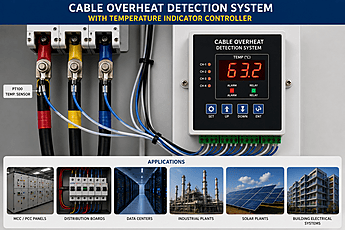
High Voltage Cable Overheat Detection is important for monitoring cable temperature and identifying abnormal heating before it causes cable damage or electrical failure. A high voltage cable overheat detection system uses temperature sensors and a temperature indicator controller to continuously monitor cable temperature and provide an alarm when the temperature exceeds a predefined limit.
What Is High Voltage Cable Overheat Detection?
High Voltage Cable Overheat Detection is a temperature monitoring solution designed to identify excessive heat in high voltage electrical cables.
High voltage cables often carry heavy electrical loads. Continuous operation, excessive current, loose connections, poor ventilation, and high ambient temperatures can increase cable temperature.
A dedicated temperature monitoring system helps operators identify these conditions at an early stage.
How Does High Voltage Cable Overheat Detection Work?
The system uses a temperature sensor installed near the high voltage cable. The sensor continuously measures the cable temperature and sends the temperature signal to the indicator controller.
The controller processes the signal and displays the measured temperature.
When the temperature reaches the configured warning level, the controller activates an alarm or output signal.
Basic operation:
Temperature Sensor → Temperature Controller → Temperature Display → Setpoint Monitoring → Alarm Output
This provides continuous monitoring without depending only on manual temperature inspections.
High Voltage Cable Temperature Monitoring
High Voltage Cable Overheat Detection provides continuous visibility of cable temperature.
The temperature controller monitors the sensor input and compares the measured temperature with preset limits.
For example:
- Normal temperature, system continues monitoring
- Temperature increases, controller indicates the rising temperature
- High temperature limit reached, alarm activates
- Abnormal temperature condition, maintenance team investigates the cause
The exact temperature limits should be selected according to the cable, insulation material, installation conditions, and manufacturer specifications.
Temperature Indicator Controller
The temperature indicator controller is the main monitoring interface of the system.
It receives the signal from the temperature sensor and displays the cable temperature to the operator.
Depending on the system design, the controller can provide:
- Real-time temperature indication
- High-temperature alarm
- Adjustable temperature setpoints
- Sensor input
- Relay output
- Digital output
- Fault indication
- Continuous temperature monitoring
This makes the temperature indicator controller useful for both monitoring and early warning applications.
Why High Voltage Cable Overheating Happens
Several factors can cause cable temperature to rise.
Electrical Overloading
Excessive current increases heat generation inside the cable. Continuous overloading can raise the conductor and insulation temperature.
Loose Connections
Loose cable connections and terminations increase electrical resistance. This can create localized heating.
Poor Ventilation
Cables installed in areas with insufficient airflow have less opportunity to dissipate heat.
High Ambient Temperature
High surrounding temperatures reduce the ability of the cable to release heat, increasing its operating temperature.
Cable Installation Conditions
Cable grouping, installation method, load conditions, and surrounding materials affect heat dissipation.
Benefits of High Voltage Cable Overheat Detection
A High Voltage Cable Overheat Detection system provides several practical benefits:
- Early detection of abnormal cable temperature
- Continuous temperature monitoring
- Reduced risk of cable overheating
- Protection against temperature-related cable damage
- Faster identification of abnormal conditions
- Improved preventive maintenance
- Reduced unexpected electrical downtime
- Better monitoring of critical electrical installations
High Voltage Cable Overheat Detection Applications
High Voltage Cable Overheat Detection systems are suitable for various electrical and industrial applications.
Common applications include:
- Electrical substations
- Power distribution systems
- Manufacturing plants
- Power generation facilities
- Industrial electrical systems
- High voltage switchgear
- Transformer connections
- Cable termination systems
- Heavy-duty electrical equipment
- Industrial control systems
Importance of a Temperature Indicator Controller
A temperature indicator controller gives operators a clear view of the cable’s operating temperature.
Without continuous monitoring, abnormal heating might remain unnoticed until the cable develops insulation damage, a termination problem, or another electrical fault.
With a temperature indicator controller, operators receive an immediate indication when the measured temperature crosses the configured limit.
This supports faster inspection and maintenance.
High Voltage Cable Overheat Detection for Preventive Maintenance
High Voltage Cable Overheat Detection supports preventive and condition-based maintenance.
For example, if a cable normally operates at a stable temperature but starts showing a continuous increase, maintenance personnel can inspect the cable before a serious failure occurs.
The team can check:
- Electrical load
- Cable connections
- Cable termination
- Insulation condition
- Ventilation
- Installation conditions
- Temperature sensor condition
Early investigation helps reduce the risk of unexpected shutdowns.
Conclusion
High Voltage Cable Overheat Detection provides an effective method for continuously monitoring the temperature of high voltage cables. When combined with a temperature indicator controller, the system provides real-time temperature indication and an early warning when the cable temperature exceeds the configured limit.
This solution is useful for substations, power distribution systems, manufacturing plants, industrial equipment, and other applications where reliable high voltage cable operation is important.
For your website, you should also add an image using this exact alt text:
High Voltage Cable Overheat Detection System with Temperature Indicator Controller
This placement should address the Yoast image alt attribute issue while keeping the blog focused on the shorter keyphrase, “High Voltage Cable Overheat Detection.”