
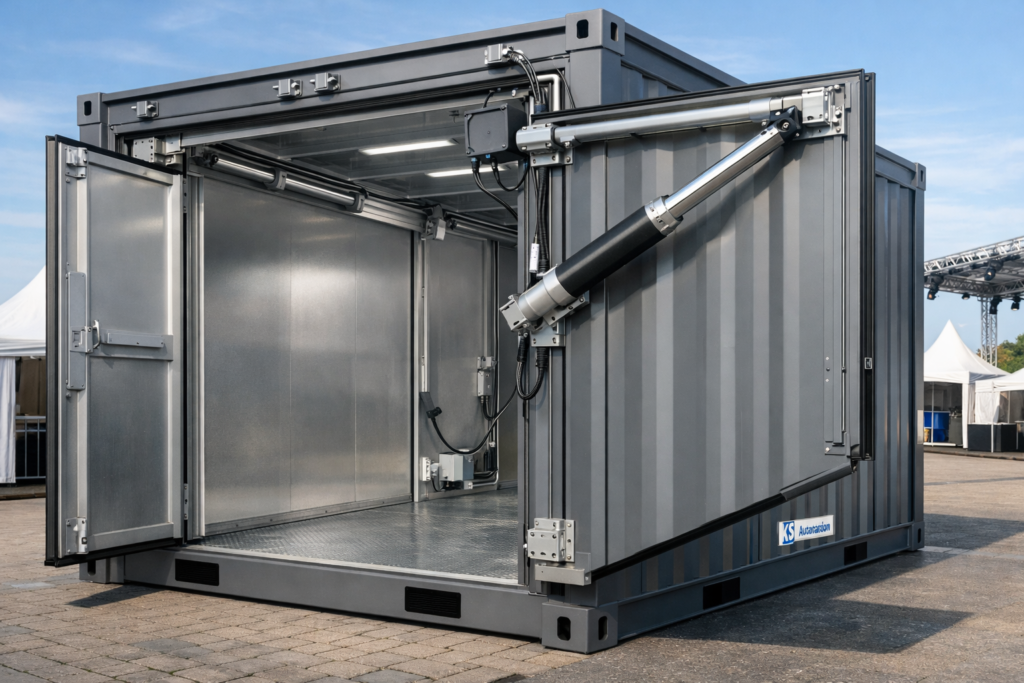
Event container doors need strong and reliable automation. However, not all actuator systems perform well outdoors. Therefore, choosing the right linear actuator is essential for smooth movement and safety. In addition, a good system improves efficiency and reduces manual work.
Key Aspects to Consider
Before selecting a solution, consider these important points:
- To begin with, choose a force between 2000N and 8000N
- Next, ensure an IP65–IP67 rating for weather protection
- At the same time, check voltage compatibility (12V or 24V DC)
- Then, select the correct stroke length (10–23 inches)
- Moreover, ensure built-in limit switches are available
- Finally, look for feedback sensors if synchronization is needed
How It is Used & Works
A linear actuator creates motion by converting electrical energy. As a result, it pushes or pulls the door easily. Initially, the actuator is mounted on the door frame. After that, it connects to a power source. Once activated, the rod moves forward or backward. Meanwhile, limit switches stop the motion automatically. In addition, dual actuators can work together. This ensures smooth movement for larger doors.
Key Application Areas & Reasons
Linear actuators are widely used in event containers. For example:
- Event setups need fast and easy door access
- Mobile shops require smooth operation
- Food stalls demand hygienic opening systems
- Security units need strong locking
- Stage containers handle heavy panels
Because of these reasons, automation improves both speed and safety.
Top Linear Actuator Solutions
Best Overall for Robustness
- Linear Actuator FY011E (24V)
- IP67 rated for outdoor durability
- Up to 8000N force
- Therefore, suitable for harsh environments
Best High-Force Option
- Kathir Sudhir Automations FY013 Model
- Offers 8000N capacity
- Uses a quiet worm gear drive
- As a result, ideal for large doors
Best Budget Option
- Fy01 24V Actuator
- Provides 6000N force
- However, has lower IP43 protection
- So, best for standard use
Best Industrial Performance
- Fy015 Model
- High speed up to 160 mm/s
- Resistant to corrosion
- Hence, perfect for industrial use
Comparison Table
| Model | Force | IP Rating | Speed | Best Use |
|---|---|---|---|---|
| FY011E | 8000N | IP67 | Medium | Outdoor heavy-duty |
| FY013 | 8000N | IP54 | Quiet | Large doors |
| Fy01 | 6000N | IP43 | Moderate | Budget |
| Fy015 | Medium-High | Industrial | High | Harsh environments |
Required Components
To build a reliable system, you will need the following:
- First, a suitable linear actuator
- Then, strong mounting brackets
- Also, a control box or relay
- In addition, a switch or remote
- Next, a power supply (5–6 amps)
- Optionally, sensors for advanced control
Operations & Functions
The actuator system performs several key functions.
It opens and closes the door smoothly. At the same time, it holds the door in position. Additionally, it stops automatically using limit switches. Furthermore, it supports remote or manual control.
Because of these functions, the system reduces human effort.
Key Features and Technology
Modern actuators include advanced features.
- For instance, worm gear drives ensure quiet operation
- Also, IP-rated sealing protects from dust and water
- In addition, built-in limit switches improve safety
- Moreover, Hall effect sensors allow synchronization
- Finally, corrosion-resistant materials increase lifespan
Key Benefits & Specifications
Benefits
- Firstly, reduces manual work
- Secondly, improves safety
- In addition, ensures smooth operation
- Lastly, increases durability
Specifications
- Force: 2000N–8000N
- Stroke: 10–23 inches
- Voltage: 12V / 24V DC
- Speed: Up to 160 mm/s
- IP Rating: IP65–IP67
Advantages and Disadvantages
Advantages
- Easy to install
- Energy efficient
- Strong and reliable
- Suitable for outdoor use
Disadvantages
- However, initial cost can be high
- Also, proper alignment is required
- In addition, power supply is necessary
- Finally, budget models have lower protection
Steps to Follow
To install the system properly, follow these steps:
- First, measure the door size and weight
- Next, select the correct actuator
- Then, install mounting brackets
- Afterward, fix the actuator securely
- Now, connect the control system
- Finally, test the full operation
Checklist for You
Before final use, review this checklist:
- Ensure correct force selection
- Confirm IP rating suitability
- Check voltage compatibility
- Verify secure installation
- Test smooth operation
Real-World Examples
For example, event containers use automated doors for quick setup. Similarly, food stalls use them for clean operation. In addition, stage containers rely on actuators for lifting panels. As a result, overall efficiency improves significantly.
Conclusion
In conclusion, linear actuator solutions play a key role in event container automation. Moreover, they offer strength, safety, and convenience. By selecting the right system, you can improve performance and reduce effort. Therefore, investing in a high-quality actuator solution is a smart choice.
FAQ
1. What is the best actuator for container doors?
Generally, 24V actuators with 6000N–8000N force are ideal.
2. How much force is required?
Typically, 2000N to 8000N is needed.
3. Can actuators be used outdoors?
Yes, especially with IP65 or higher ratings.
4. Which voltage is better?
12V works for small systems, while 24V suits heavy-duty use.
5. Do actuators need maintenance?
No, they require minimal maintenance.
6. Can two actuators be used together?
Yes, especially with synchronization sensors.
7. What is stroke length?
It is the distance the actuator rod moves.
8. Are actuators safe?
Yes, especially with built-in limit switches.
9. How are actuators controlled?
They use switches, remotes, or control systems.
10. What is the lifespan?
Usually, several years with proper usage.