
The plastic and rubber industries need accuracy, speed, and clean production. Because of this, many companies are changing their machines. Instead of hydraulics, they now use electric actuator.
Electric actuators give smooth and exact motion. At the same time, they reduce leaks and noise. As a result, product quality improves. Moreover, maintenance costs go down. In this blog, we clearly explain where the plastic and rubber industry uses electric actuators and why they matter.
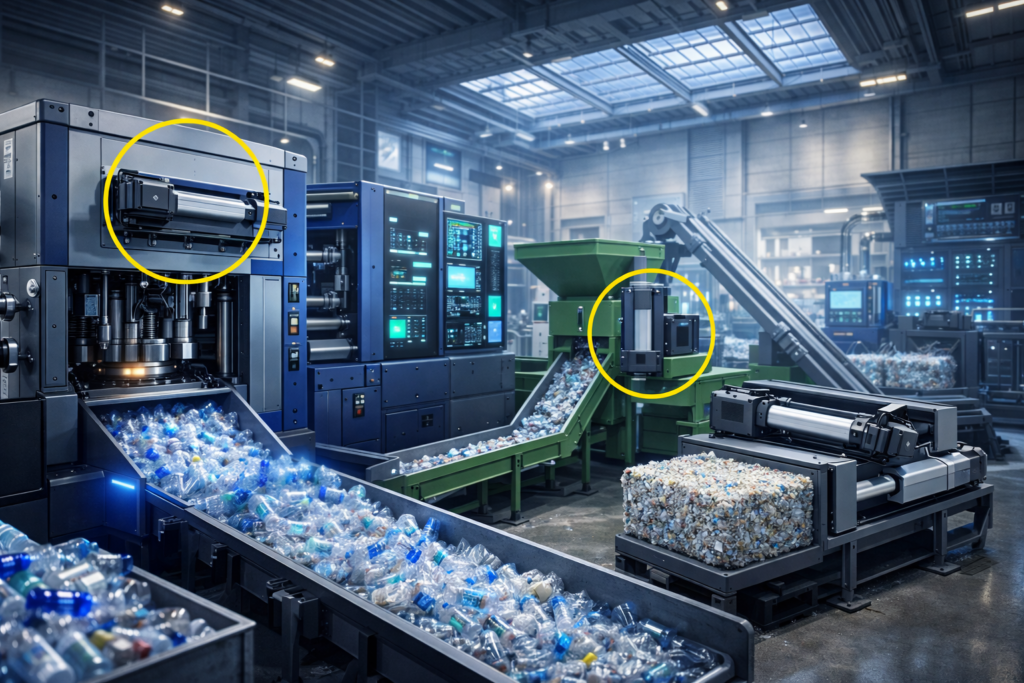
Automation in Plastic Reprocessing Plants & Waste Shredding Systems
Plastic reprocessing plants handle large amounts of waste. Therefore, strong and controlled machines are needed. Electric linear actuators help make this possible.
For example, electric linear actuators are used to:
- Move shredder blades smoothly
- Control pressing and compacting units
- Open and close feeder gates
- Apply steady force during shredding
In addition, electric linear actuators do not use oil. Because of this, they keep recycling lines clean. At the same time, they lower service time and energy use. Consequently, recycling becomes more efficient.
Electric Actuator for Plastic & Rubber Crushing Machines
Crushing machines must apply the right pressure every time. Therefore, motion control must be accurate. Electric actuators meet this need.
They are used to:
- Control jaw movement
- Adjust crushing force
- Align material feed paths
- Synchronize crushing stages
Moreover, electric actuators work quietly. Compared to hydraulic systems, they use less power. As a result, operating costs are lower.
Precision Actuation in Cricket Ball Manufacturing
Cricket ball production needs strict control. Because of this, each step must be precise. Electric linear actuators help achieve this goal.
They support:
- Rubber molding and compression
- Core positioning and pressing
- Controlled curing processes
As a result, every ball meets quality standards. In addition, material waste is reduced. Therefore, manufacturers gain better output and consistency.
Electric Actuator in Plastic Manufacturing Processes
Electric actuators are used across many plastic processes. Because they are accurate and clean, they fit modern factories well.
Injection Molding Applications
For injection molding, electric linear actuators help with:
- Mold positioning
- Gate valve control
- Core pull movement
- Part ejection
As a result, cycle time improves and defects reduce.
Thermoforming & Blow Molding
In these processes, electric actuators control:
- Mold clamping
- Die positioning
- Extrusion movement
Therefore, product shape and thickness stay consistent.
Welding, Sealing & Clean Manufacturing
Electric linear actuators are also used for:
- Ultrasonic welding
- Sealing operations
- Clean positioning for food and medical plastics
Because there is no oil, contamination risk is very low.
Material Handling & Packaging
In addition, electric actuators power:
- Conveyor systems
- Sorting units
- Lifting mechanisms
As a result, material flow becomes smooth and reliable.
Improving Efficiency & Supporting Sustainability
Today, factories focus on saving energy. Therefore, electric linear actuators are a smart choice.
They help by:
- Reducing power use
- Removing oil leakage
- Cutting maintenance work
- Reducing downtime
Moreover, electric actuators use power only when moving. Because of this, energy waste is low. Consequently, carbon emissions reduce.
Key Benefits of Electric Actuator
Electric linear actuators offer many clear benefits:
- Accurate and repeatable motion
- Clean and leak-free operation
- Quiet and safe performance
- Easy PLC integration
- Stable product quality
Because of these advantages, they are ideal for new machines. Likewise, they work well for upgrades.
The Future of Actuation Technology in Plastics
The plastic and rubber industry is changing fast. Therefore, automation is increasing. Electric linear actuators will play a bigger role.
Future developments include:
- IoT-enabled actuators
- Live performance monitoring
- Predictive maintenance
- Compact designs with high force
As a result, factories will become smarter and more reliable.
Conclusion: Electric Actuator in the Plastic Industry
In conclusion, electric linear actuators are essential in plastic and rubber manufacturing. They are used in recycling, crushing, injection molding, and cricket ball production. Overall, they offer clean motion, high accuracy, and energy savings. Therefore, as automation grows, electric actuators will continue to shape the future of the plastic and rubber industry.