
In a tyre manufacturing company, precision and stability play a crucial role in every production stage — from material loading to final quality inspection. One of the often-overlooked yet essential movements in the process is lifting and holding heavy tyre molds or components during assembly, curing, or testing. Traditionally, this has been achieved using pneumatic or hydraulic systems, but now, the trend is shifting toward a cleaner, smarter, and more efficient solution — Electric Linear Actuators.
The Challenge in Tyre Manufacturing
In a high-volume tyre production environment, operators must frequently lift, align, and hold tyres or molds at specific positions for curing, inspection, or robotic processing.
Hydraulic and pneumatic systems used earlier come with certain drawbacks — oil leaks, maintenance issues, complex plumbing, and inconsistent positioning accuracy. Moreover, modern factories demand automation with precise control and minimal downtime, which traditional systems fail to deliver efficiently.
The Electric Actuator Advantage
By replacing hydraulic or pneumatic systems with Electric Linear Actuators, tyre manufacturers gain smoother control, consistent speed, and precise positioning — all without the mess of fluid leakage or high maintenance costs.
Electric actuators can lift and hold heavy components like tyre molds or rollers with high load-bearing capacity, ensuring the process remains steady and vibration-free.
They are also highly programmable and can integrate easily with PLC or industrial control units for automation.
Key Benefits:
- High precision lifting and positioning
- Smooth and silent operation
- Zero oil leakage and reduced maintenance
- Compact and clean design
- Programmable for different lifting heights
- Long life cycle with consistent performance
Real Application Scenario
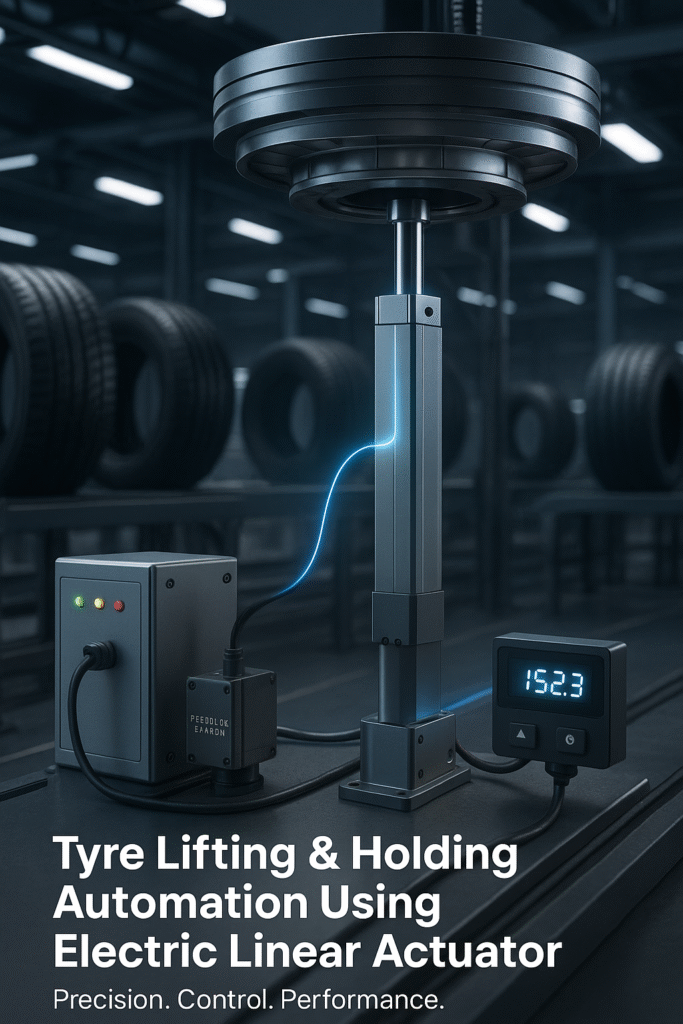
In one of the leading tyre manufacturing setups, Electric Linear Actuators were installed in the tier lifting station, where moulds and rubber assemblies needed to be raised and held firmly for curing.
The actuators provided stable and repeatable movement, replacing the need for complex hydraulic cylinders.
With the addition of a control unit and feedback sensors, operators could monitor the lifting height and adjust precisely during every cycle.
This upgrade led to a significant reduction in downtime and improved process consistency, proving how electric actuation can modernize even the most demanding industrial environments.
Conclusion
As tyre manufacturing evolves toward smarter, cleaner production lines, Electric Linear Actuators stand out as the most reliable solution for lifting and holding applications.
They deliver accuracy, efficiency, and simplicity — aligning perfectly with the goals of modern automation.
Nice article