
The recreational vehicle (RV) industry is continuously evolving to provide greater comfort, convenience, and space efficiency for travelers. One of the key technologies enabling this transformation is the actuator control system, particularly in RV slide-out mechanisms.
Modern RVs use electric actuators to automate the movement of slide-out rooms, storage compartments, adjustable beds, leveling systems, and other movable structures. These systems enhance the user experience by delivering smooth, reliable, and precise motion control.
What is an RV Slide-Out System?
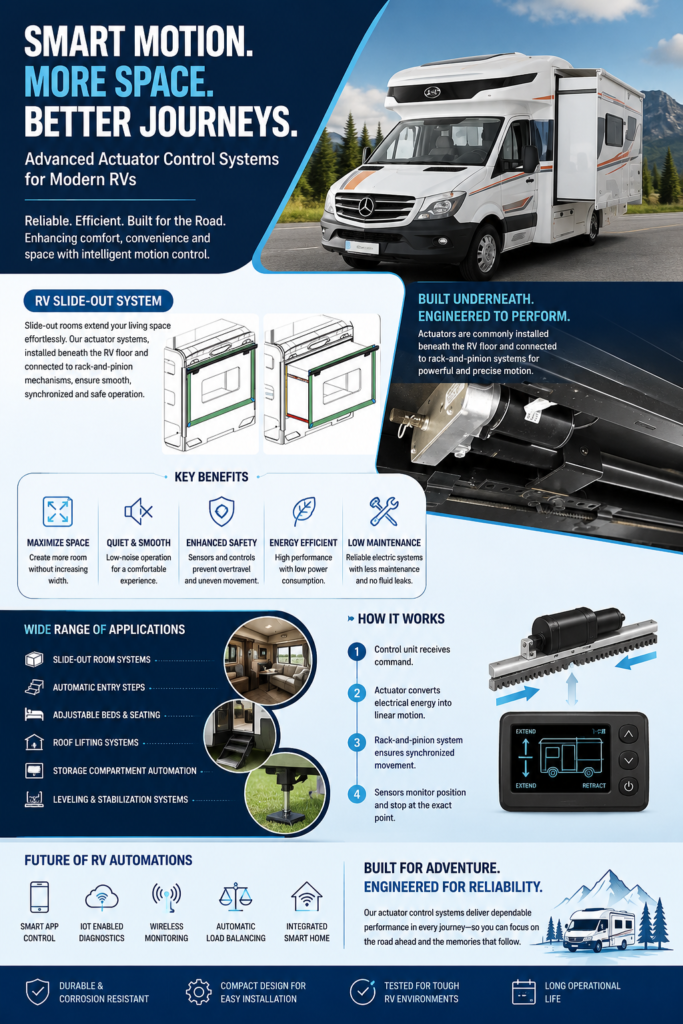
An RV slide-out system is a movable section of the vehicle that extends outward when parked, increasing interior living space. Slide-outs are commonly used in motorhomes, travel trailers, and camper vans to create additional room for seating areas, kitchens, or sleeping spaces.
Electric actuator systems are the driving force behind these slide-out mechanisms. Actuators are commonly installed beneath the RV floor and connected to rack-and-pinion systems, allowing synchronized linear motion for safe and stable extension and retraction.
How Actuator Control Systems Work
The actuator control system typically consists of:
- Electric linear actuators or geared motors
- Rack-and-pinion drive mechanisms
- Electronic control units (ECU)
- Position sensors and limit switches
- Power distribution and safety circuits
When activated, the actuator converts electrical energy into controlled linear motion. The rack-and-pinion assembly ensures balanced movement of the slide-out section, minimizing vibration and mechanical stress.
The control system manages:
- Smooth extension and retraction
- Synchronization of multiple actuators
- Overload protection
- Position monitoring
- Automatic stop functions
Advantages of Electric Actuator Systems in RVs
Space Optimization
Slide-out systems significantly increase interior living space without increasing the vehicle’s road width.
Quiet and Smooth Operation
Electric actuators provide low-noise movement, improving user comfort during operation.
Enhanced Safety
Integrated sensors and control modules help prevent uneven movement, jamming, or overtravel conditions.
Energy Efficiency
Modern actuator systems consume less power while delivering high torque performance.
Reduced Maintenance
Compared to hydraulic systems, electric actuators require less maintenance and eliminate the risk of hydraulic fluid leakage.
Applications of Actuator Systems in RVs
Electric actuator technology is widely used across various RV applications, including:
- Slide-out room systems
- Automatic entry steps
- Adjustable seating and beds
- Roof lifting systems
- Storage compartment automation
- Leveling and stabilization systems
Importance of Reliable Motion Control
RV environments are exposed to vibration, dust, moisture, and changing weather conditions. Therefore, actuator control systems must be designed for:
- High durability
- Corrosion resistance
- Compact installation
- Long operational life
- Stable performance under varying loads
Advanced control systems also improve synchronization between actuators, ensuring accurate positioning and reliable operation over thousands of cycles.
Future Trends in RV Automation
As smart mobility and connected vehicle technologies continue to grow, RV actuator systems are becoming more intelligent. Future developments include:
- Smart app-based control
- Wireless monitoring systems
- IoT-enabled diagnostics
- Automatic load balancing
- Integrated smart home features inside RVs
These innovations are expected to further improve convenience, safety, and automation within the RV industry.
Conclusion
Actuator control systems play a vital role in modern recreational vehicles by enabling efficient and reliable slide-out operations. Installed beneath the RV floor and connected to rack-and-pinion systems, these actuators deliver smooth motion, optimized space utilization, and improved user comfort.
As RV technology advances, electric actuator solutions will continue to drive innovation in automated mobility, smart living, and compact space management for recreational vehicles.