
Modern manufacturing and warehouse operations demand faster, safer, and more flexible palletizing systems. However, traditional robotic palletizers often struggle to reach higher pallet layers without increasing the robot’s footprint or using expensive robotic arms. Therefore, integrating a Column Actuator for Cobot Palletizer is an ideal solution for extending the vertical working range while maintaining precision and safety.
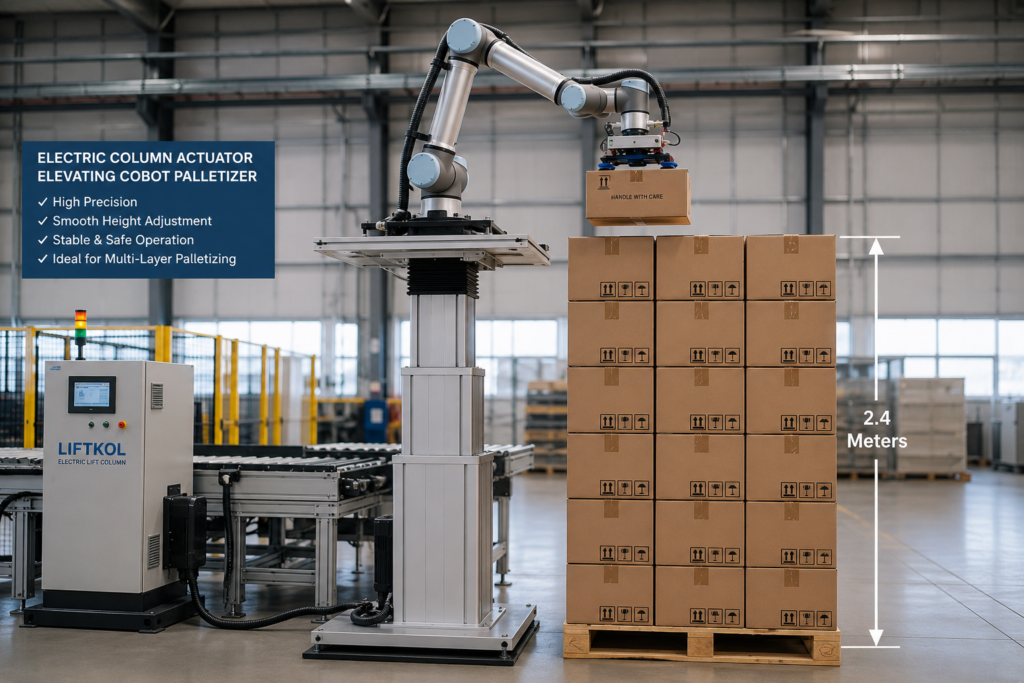
In addition, electric column actuators improve palletizing efficiency, reduce installation costs, and allow collaborative robots (cobots) to handle multiple pallet heights without requiring complex mechanical systems.
Best Column Actuator Technology for Cobot Palletizers
A lifting column actuator provides stable vertical movement for collaborative robots by converting electrical energy into smooth linear motion. As a result, the cobot can automatically move up and down to place boxes accurately on every pallet layer.
Unlike hydraulic or pneumatic lifting systems, electric lifting columns are:
- Maintenance-free
- Energy efficient
- Quiet during operation
- Highly accurate
- Easy to integrate with robotic systems
Therefore, they are becoming the preferred solution for Industry 4.0 palletizing applications.
Key Aspects to Consider
Before selecting a lifting column actuator for your cobot palletizer, consider the following factors:
- First, choose a lifting capacity between 1000N and 8000N
- Next, select a lifting height according to pallet dimensions (500–2000 mm)
- Then, ensure compatibility with 24V DC or 48V DC power supply
- Also, verify positioning accuracy for robotic applications
- Moreover, select an actuator with IP54–IP65 protection
- Check duty cycle for continuous industrial operation
- Choose built-in limit switches
- Finally, select models supporting encoder or Hall sensor feedback for precise positioning
How It Works
A column actuator lifts the collaborative robot vertically.
Initially, the lifting column is mounted beneath the cobot base.
Next, the actuator connects to the robot controller and power supply.
When palletizing begins, the cobot places boxes on the lower pallet layers.
As the pallet height increases, the actuator raises the cobot automatically.
Meanwhile, encoder feedback ensures accurate height positioning.
Finally, the cobot reaches every pallet layer without extending its robotic arm beyond safe operating limits.
As a result, the palletizing process becomes faster, safer, and far more efficient.
Selection Table
| Requirement | Recommended Specification |
|---|---|
| Lifting Capacity | 1000N–8000N |
| Lift Height | 500–2000 mm |
| Voltage | 24V / 48V DC |
| Speed | 20–100 mm/s |
| Protection | IP54–IP65 |
| Position Feedback | Hall Sensor / Encoder |
| Duty Cycle | Industrial Continuous |
Key Application Areas & Reasons
Column actuators are widely used across automated industries.
For example:
- Cobot palletizing stations
- Warehouse automation
- Packaging industries
- Food processing plants
- Logistics centers
- Pharmaceutical manufacturing
- E-commerce fulfillment
- Industrial material handling
Because of these applications, lifting columns improve productivity while reducing the factory floor space required.
Top Column Actuator Solutions
Best Overall Performance
Heavy-Duty Electric Lifting Column
- High load capacity
- Smooth vertical movement
- Excellent positioning accuracy
- Ideal for collaborative robots
Therefore, suitable for advanced palletizing systems.
Best Industrial Solution
Kathir Sudhir Automation Column Actuator
- High-strength aluminum profile
- Long service life
- Encoder feedback available
- Low maintenance
As a result, ideal for industrial automation projects.
Best High-Speed Model
Servo-Controlled Lift Column
- Fast lifting speed
- Precision positioning
- Excellent repeatability
- Supports Industry 4.0 integration
Hence, perfect for high-speed packaging industries.
Best Budget Solution
Standard Electric Lift Column
- Affordable
- Easy installation
- Compact design
- Suitable for light-duty palletizing
Therefore, ideal for small manufacturing facilities.
Comparison Table
| Model | Capacity | Lift Height | Protection | Best Application |
|---|---|---|---|---|
| Heavy Duty Column | 8000N | Up to 2000 mm | IP65 | Industrial Palletizer |
| Kathir Sudhir Column | 6000N | 1500 mm | IP54 | Cobot Automation |
| Servo Lift Column | 4000N | 1800 mm | IP65 | High-Speed Production |
| Standard Column | 2000N | 1000 mm | IP54 | Budget Automation |
Required Components
To build a complete cobot palletizer system, you will need:
- Electric column actuator
- Collaborative robot (Cobot)
- Mounting plate
- Robot controller
- Motor driver
- Power supply
- Position sensors
- Emergency stop switch
- Safety enclosure (if required)
- Communication cables
Operations & Functions
The lifting column performs several important tasks.
It raises the cobot smoothly.
It lowers the cobot accurately.
It positions the robot at every pallet layer.
It provides stable vertical movement.
It improves robot reach.
It supports synchronized motion with robotic software.
Consequently, palletizing becomes more efficient and highly accurate.
Key Features and Technology
Modern lifting columns include advanced industrial technology.
For instance:
- Precision ball screw mechanism
- High-strength aluminum body
- Quiet electric motor
- Built-in limit switches
- Hall effect sensor feedback
- Encoder positioning
- Overload protection
- Maintenance-free operation
- Low power consumption
- PLC and robot controller compatibility
Key Benefits & Specifications
Benefits
- Increases palletizing height
- Reduces robot footprint
- Improves productivity
- Enhances worker safety
- Saves factory space
- Low maintenance
- Quiet operation
- Easy automation integration
Specifications
| Specification | Value |
|---|---|
| Load Capacity | 1000N–8000N |
| Lift Height | 500–2000 mm |
| Voltage | 24V / 48V DC |
| Speed | 20–100 mm/s |
| Protection | IP54–IP65 |
| Feedback | Encoder / Hall Sensor |
| Duty Cycle | Industrial Grade |
Advantages and Disadvantages
Advantages
- High positioning accuracy
- Smooth lifting operation
- Compact footprint
- Long operational life
- Energy efficient
- Easy installation
- Quiet performance
- Compatible with collaborative robots
Disadvantages
- Higher initial investment
- Requires accurate alignment
- Limited by maximum lifting capacity
- Needs stable electrical power
Installation Steps
Follow these steps for successful installation:
- Measure the required lifting height.
- Select the appropriate lifting column.
- Install the mounting frame.
- Secure the column actuator.
- Mount the cobot on the lifting platform.
- Connect power and controller.
- Configure robot communication.
- Calibrate lifting positions.
- Test vertical movement.
- Verify palletizing accuracy.
Installation Checklist
Before commissioning the system, ensure:
✔ Correct lifting capacity selected
✔ Proper mounting completed
✔ Voltage compatibility verified
✔ Safety switches functioning
✔ Encoder calibration completed
✔ Smooth lifting movement
✔ Emergency stop tested
✔ Robot communication verified
Real-World Applications
Column actuators are transforming modern industrial automation.
For example, logistics companies use lifting columns to automate pallet stacking.
Similarly, food manufacturers rely on them for hygienic packaging operations.
In addition, pharmaceutical industries use cobot palletizers for precision product handling.
Warehouse automation systems also utilize electric lifting columns to maximize storage efficiency.
As a result, businesses achieve faster production, reduced labor costs, and improved workplace safety.
Conclusio
In conclusion, a Column Actuator for Cobot Palletizers is an essential component for modern automated palletizing systems. It significantly extends the working range of collaborative robots while maintaining precision, stability, and safety. Moreover, electric lifting columns reduce floor space requirements, improve operational efficiency, and support Industry 4.0 manufacturing standards.
Therefore, investing in a high-quality column actuator is a smart choice for businesses looking to increase productivity, minimize manual handling, and future-proof their automation systems.
Frequently Asked Questions (FAQ)
1. What is a column actuator for a cobot palletizer?
It is an electric lifting column that raises or lowers a collaborative robot to reach different pallet heights accurately.
2. Why use a lifting column instead of a larger robot?
A lifting column extends the robot’s vertical reach without increasing the robot size or footprint, making the system more cost-effective.
3. What lifting capacity is recommended?
Most industrial applications require lifting capacities between 1000N and 8000N, depending on the cobot and payload.
4. Which voltage is commonly used?
24V DC is the most common, while 48V DC is used for higher-performance industrial systems.
5. Can lifting columns operate continuously?
Yes. Industrial-grade lifting columns are designed for continuous-duty automation when operated within their rated duty cycle.
6. Are column actuators suitable for collaborative robots?
Yes. They are specifically designed to work with cobots, providing stable and precise vertical positioning.
7. What type of feedback is available?
Most models support Hall effect sensors, encoders, or other position feedback systems for accurate motion control.
8. Do column actuators require regular maintenance?
No. Electric lifting columns are generally maintenance-free and require only periodic inspections.
9. Which industries use cobot lifting columns?
They are widely used in warehousing, logistics, food processing, pharmaceuticals, packaging, electronics, automotive manufacturing, and e-commerce fulfillment.
10. What are the main benefits of using a column actuator?
The main benefits include increased palletizing height, improved accuracy, enhanced safety, reduced floor space, lower maintenance, and higher overall productivity.