
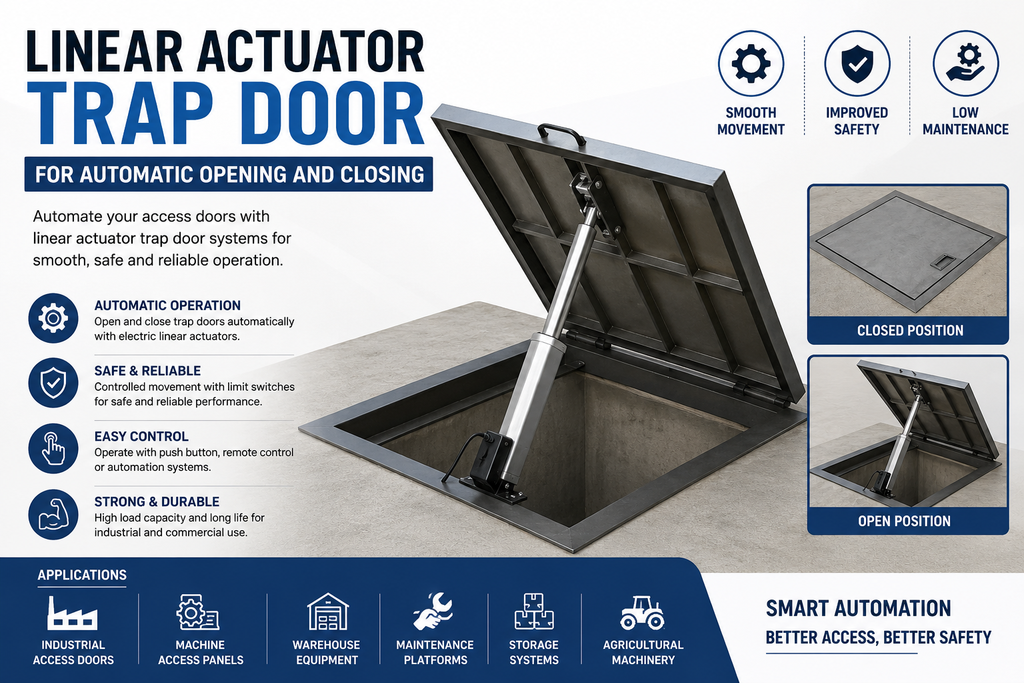
A linear actuator trap door system provides a simple way to automate the opening and closing of access doors. An electric linear actuator produces controlled linear movement, reducing manual effort and making trap door operation easier.
Linear Actuator Trap Door System
A linear actuator trap door system uses an electric actuator to lift and lower a trap door. The actuator connects between the fixed frame and the moving door.
When the actuator extends, it pushes the door upward. When it retracts, the door returns to its closed position.
The system typically includes:
- Electric linear actuator
- Trap door
- Mounting brackets
- Power supply
- Control switch
- Limit switches
- Safety control system
How Does a Linear Actuator Lift a Trap Door?
The linear actuator converts electrical energy into linear motion. This motion moves the trap door through a controlled opening and closing cycle.
The actuator mounting position plays an important role in the system. The required force depends on the door weight, dimensions, hinge position, opening angle, and mounting points.
A properly selected linear actuator provides smooth and stable trap door movement.
Benefits of a Linear Actuator Trap Door
A linear actuator trap door system offers several practical benefits:
- Automatic door operation
- Reduced manual effort
- Smooth opening and closing
- Controlled movement
- Easy push-button operation
- Compact installation
- Remote control integration
- Suitable for repeated operation
- Easy integration with automation systems
These features make electric actuators suitable for industrial and commercial access applications.
Applications of Linear Actuator Trap Door Systems
A linear actuator trap door system works well in different applications, including:
- Industrial access doors
- Machine access panels
- Underground access hatches
- Maintenance platforms
- Warehouse equipment
- Storage systems
- Agricultural machinery
- Commercial access doors
- Automated machinery
- Service access panels
The actuator specification should match the operating requirements of each application.
Choosing the Right Linear Actuator
Selecting the correct actuator is important for reliable trap door operation.
Consider these factors before selecting an actuator:
Load Capacity
Check the weight of the trap door and calculate the required lifting force. The mounting position also affects the required actuator force.
Stroke Length
Stroke length determines how far the actuator extends and retracts. Select a stroke based on the required movement of the trap door.
Operating Speed
Choose the actuator speed according to the required opening and closing time.
Voltage
12V DC and 24V DC actuators are common choices for automation systems. Select the voltage according to your available power supply.
Mounting Dimensions
Check the actuator’s retracted and extended lengths. Ensure enough space is available for installation.
Duty Cycle
For frequently operated trap doors, select an actuator suitable for the required operating cycle.
Automatic Trap Door Control
You can operate a linear actuator trap door system using a simple switch or an automated control system.
Possible control options include:
- Push-button switch
- Remote control
- Relay controller
- PLC
- Control panel
- Sensor-based control
- Custom automation controller
Limit switches help stop the actuator at the required positions. Safety interlocks can also be added based on the application requirements.
Safety Considerations
Safety should be part of every automated trap door design.
Use suitable mounting brackets and select an actuator based on the actual load. Add limit switches and suitable electrical protection where required.
For applications where people work near the moving door, consider safety interlocks and emergency stop functions to reduce the risk of accidental movement.
Why Use Electric Linear Actuators?
Electric linear actuators provide a practical solution for applications where you need controlled linear movement.
Compared with manual trap door operation, an electric actuator provides:
- Consistent movement
- Controlled positioning
- Simple electrical control
- Easy automation integration
- Reduced physical effort
- Compact mechanical design
This makes linear actuator systems suitable for industrial automation and customized machinery.
Conclusion
A linear actuator trap door system provides a reliable method for automating trap door opening and closing. The actuator lifts the door through controlled linear movement and returns it to the closed position.
By selecting the correct force, stroke, speed, voltage, and mounting arrangement, you can build a practical trap door automation system for industrial and commercial applications.
Kathir Sudhir Automation provides electric linear actuators and customized automation solutions for different industrial applications.