
The cement industry plays a vital role in infrastructure development, but it also faces challenges related to environmental control and workplace safety. One of the major concerns in cement plants is odor generation from material handling, waste processing, sludge treatment, alternative fuel systems, and exhaust gas handling. Effective odor control systems are essential to maintain air quality, comply with environmental regulations, and create a safer working environment.
Modern odor control systems increasingly rely on Electric Actuators for accurate, reliable, and energy-efficient automation.
Why Odor Control is Important in Cement Plants
Odors in cement manufacturing facilities can originate from:
- Alternative fuel and raw material handling
- Waste-derived fuel storage areas
- Sewage treatment plants
- Sludge processing units
- Chemical dosing systems
- Exhaust and ventilation systems
Uncontrolled odors can lead to:
- Employee discomfort
- Environmental complaints from nearby communities
- Regulatory non-compliance
- Poor indoor air quality
- Reduced operational efficiency
To address these issues, automated odor control systems are implemented using dampers, valves, ventilation systems, and chemical dosing units — all requiring precise motion control.
Role of Electric Actuators in Odor Control Systems
Electric Actuators are used to automate the movement of valves, dampers, louvers, and ventilation mechanisms in odor control applications.
They help regulate:
- Airflow control
- Chemical injection systems
- Exhaust gas routing
- Ventilation dampers
- Scrubber systems
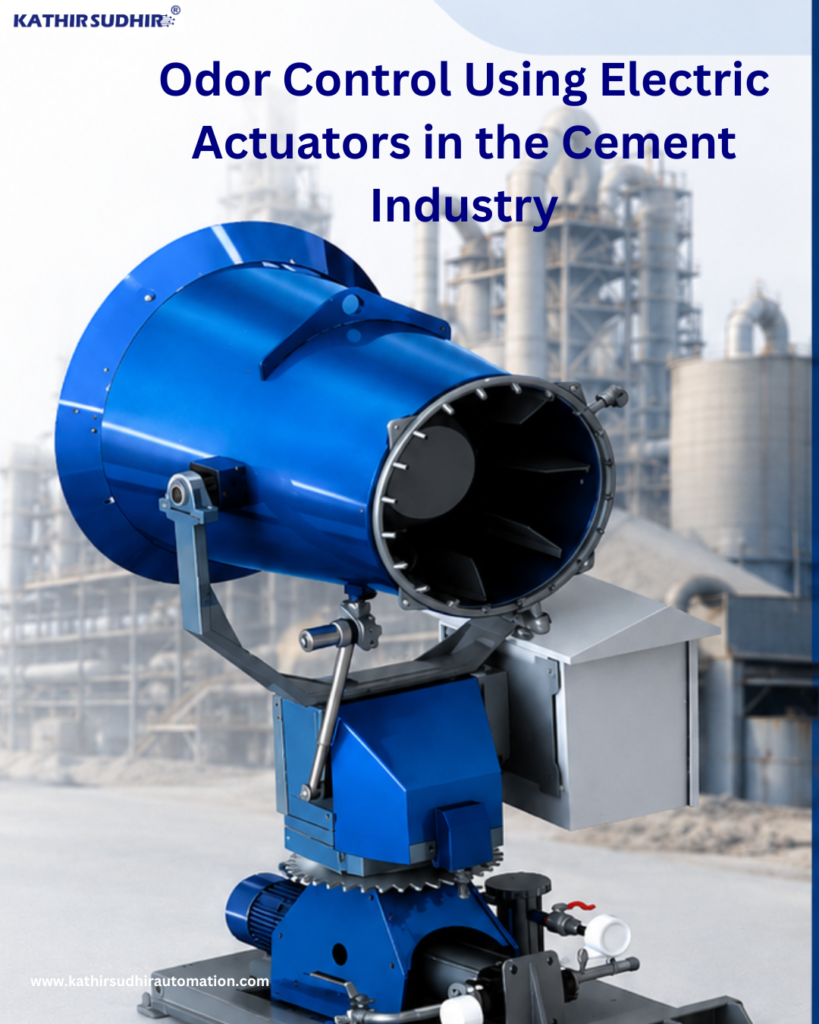
- Mist and spray systems
With precise positioning and automated operation, Electric Actuators ensure efficient odor management while reducing manual intervention.
Applications in Cement Industry Odor Control
1. Ventilation Damper Automation
Electric Actuators control dampers in ventilation ducts to regulate airflow and remove contaminated air from processing areas.
2. Chemical Scrubber Systems
In wet scrubber systems, actuators automate valves for chemical dosing and flow regulation to neutralize harmful gases and odors.
3. Dust and Fume Extraction Systems
Electric Actuators help manage extraction systems by controlling louvers and airflow channels for efficient odor and dust removal.
4. Alternative Fuel Handling Areas
Cement plants using RDF or waste-based fuels often experience strong odors. Automated dampers and exhaust controls help maintain proper ventilation.
5. Wastewater Treatment Sections
Actuators automate odor suppression systems and airflow management in sewage and wastewater treatment units within the plant.
Advantages of Using Electric Actuators
Precise Control
Electric Actuators provide accurate positioning for airflow and valve control, improving odor treatment efficiency.
Energy Efficient
Unlike pneumatic systems, electric actuators consume power only during operation, reducing energy costs.
Low Maintenance
Electric Actuators require minimal maintenance due to fewer moving parts and no compressed air system.
Reliable Automation
They support continuous automated operation with high repeatability and dependable performance.
Remote Monitoring & Control
Modern actuators support integration with PLC, SCADA, and industrial automation systems for centralized monitoring.
Environment Friendly
Electric Actuators help reduce air leakage and improve process efficiency, supporting sustainable plant operations.
Key Features of Electric Actuators for Odor Control
- IP-rated weatherproof design
- Corrosion-resistant construction
- Modulating and on/off control options
- Compact and space-saving design
- Torque overload protection
- Manual override facility
- Compatibility with industrial automation systems
Future of Smart Odor Control Systems
With increasing environmental standards and industrial automation trends, cement plants are adopting intelligent odor control systems integrated with sensors and automated actuators.
Electric Actuators play a major role in:
- Smart ventilation management
- Real-time odor monitoring
- Automated airflow balancing
- Predictive maintenance systems
- Energy optimization
These technologies improve operational efficiency while supporting cleaner and safer industrial environments.
Conclusion
Odor control is becoming an essential part of modern cement plant operations. By integrating Electric Actuators into odor control systems, industries can achieve precise automation, improved environmental compliance, reduced maintenance, and better workplace conditions.
As cement plants continue moving toward smart and sustainable automation, Electric Actuators provide a reliable and efficient solution for advanced odor management applications.